No Matter What You Choose, You’ll Be Late to Something
The invisible timeline women are measured against — and why it was never designed to be winnable.

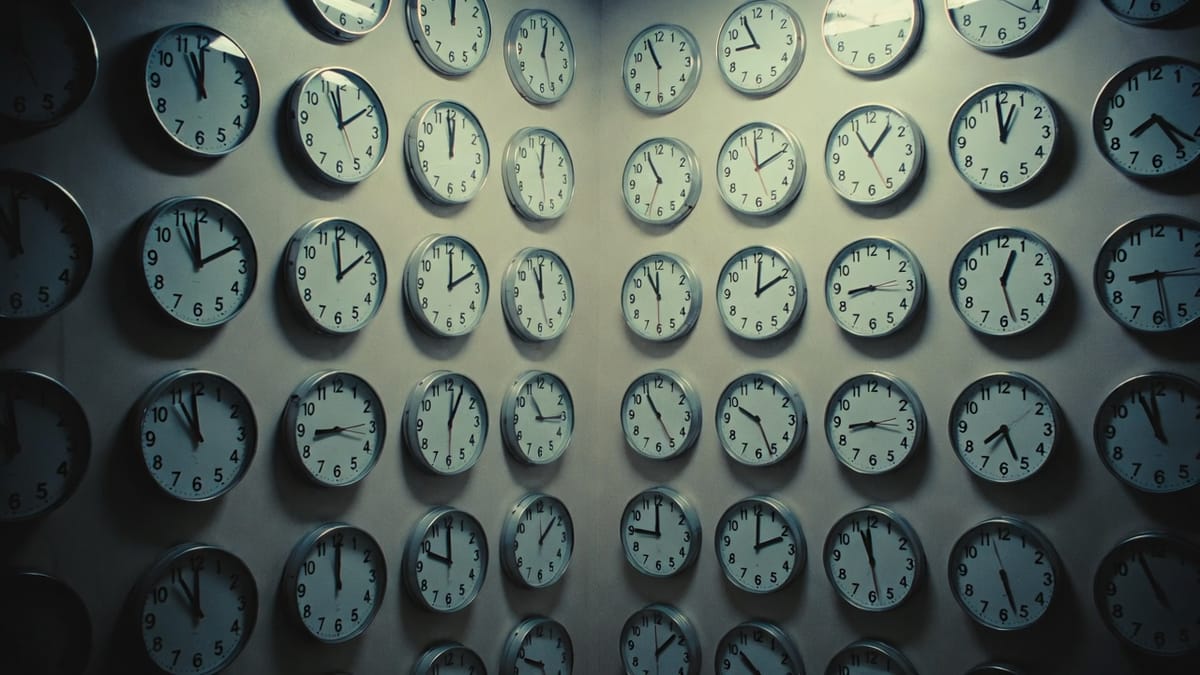
You didn’t fall behind. You were measured against a timeline that keeps moving the moment you reach it.
You don’t remember when the timeline begins, because no one ever explains it to you. There is no moment where someone sits you down and says: this is how your life should unfold, this is the pace you should follow, this is how you will know if you are doing it correctly. Instead, it forms around you quietly. You hear it in the way adults describe other girls, in the way someone is praised for being mature for her age, or gently questioned for still seeming “a bit behind.” You notice reactions before you understand what they mean, a look that lingers slightly too long, a comparison that was not directed at you but somehow still lands. You absorb it without realizing you are absorbing it.
At some point, you begin to understand that time is not just something that passes, it is something you are expected to match. That there is a correct pace to becoming, and that pace is not defined by you. You can be early, you can be late, but you cannot simply be. And somehow, both being early and being late feel like quiet misalignments, like subtle deviations from something no one ever fully explains but everyone seems to understand. So before you even develop a sense of self, you develop a sense of timing, and once you see it, you cannot unsee it.
There is a specific kind of awareness that begins early, long before you would ever call it pressure. It arrives as observation. You start noticing that your body, your behavior, your interests are not just yours, they are being interpreted. You are not just growing, you are growing in public. Too feminine too early, and there is concern. Too indifferent to femininity, and there is also concern. You learn, without being told directly, that there is a narrow corridor of acceptable timing, and that corridor moves depending on who is watching. So you begin to regulate yourself, not dramatically, just enough to stay within range, because it becomes clear that it is not enough to become, you must become at the right speed. And the unsettling part is that the right speed is never stable, it shifts depending on context, culture, generation, which means you are constantly recalibrating yourself against something that was never fixed to begin with.
Your twenties are introduced to you as freedom, as possibility, as the most open version of your life, and in many ways they are. But underneath that narrative, there is another one running quietly in parallel: urgency. You should explore, but not waste time. You should fall in love, but not stay too long in the wrong place. You should build something, but not at the cost of everything else. Every path is framed as temporary, every choice carrying an invisible timer. There is always a next stage implied, a suggestion that this is not where you are meant to stay, only where you are meant to pass through correctly. So even in moments that are supposed to feel free, there is a low, constant awareness of time moving, not in a way that stops you, but in a way that prevents you from fully settling into where you are. You don’t just live your twenties, you monitor them.
At some point, you begin to notice something almost absurd in its consistency: there is no pace that escapes interpretation. If you move slowly, you are falling behind. If you move quickly, you are rushing into things. If you pause, you are stagnating. If you change direction, you are unstable. There is no version of movement that is simply accepted as movement. Everything is read, positioned, evaluated. And so you begin adjusting not only what you do, but how it might be perceived. You anticipate reactions before they happen, you soften your decisions, justify your timelines, explain yourself, sometimes out loud, often only internally, because somewhere along the way, neutrality disappeared. Living stopped being something you simply experience, and became something you are constantly framing, even to yourself.
You are told that love will come naturally, that it cannot be forced, that it arrives when you least expect it, and at the same time, you are subtly warned not to wait too long, not to become too independent, not to miss the moment when it is supposed to happen. No one explains how both of these realities are meant to coexist. So you move between patience and quiet panic, between trusting the process and questioning it. You wonder if you are being too selective or not selective enough, too open or too closed. Every relationship feels like both an opportunity and a risk, every ending feels like both clarity and the quiet suspicion that something has been lost that cannot be recovered in the same way. Love is presented as something organic, but experienced as something timed.
You are encouraged to build something for yourself, to be independent, to have your own direction, your own stability, your own identity that does not rely on anyone else, and yet there is an unspoken boundary around how far that independence is allowed to go. Too focused, and you risk being seen as disconnected. Too ambitious, and you risk being seen as difficult. There is a version of success that is celebrated, but it is carefully calibrated. You are expected to grow, but not in a way that disrupts relational expectations, to achieve, but not in a way that makes you inaccessible, to be strong, but still available. So your life begins to split into layers: what you want, what is expected, what is acceptable, what is admired, and navigating between them becomes its own kind of work.
There is no other life path that carries the same weight of biological framing as motherhood. Even if you are unsure, even if you are distant from the idea, even if you have decided it may not be for you, the timeline still exists in the background, not always loudly, but persistently. It appears in conversations that are framed as casual, in comments that seem harmless but linger longer than they should, in the way certain ages are spoken about as if they carry meaning beyond the number itself. And what makes it uniquely complex is that it is not purely social, it is tied to something physical, something finite, something that cannot be entirely ignored. So even without urgency, there is awareness, even without desire, there is consideration, and that alone is enough to shape decisions in ways that are difficult to trace back to a single cause.
You are told you can have everything: career, love, stability, freedom, a sense of self that remains intact through all of it. It sounds generous, empowering, but what is rarely explained is not whether you can have it all, but when, and at what cost. Because these things do not simply coexist, they compete. Each one requires a version of you that slightly conflicts with the others. To build something meaningful requires focus, to sustain intimacy requires availability, to maintain yourself requires space, and there are only so many ways to distribute those things without something eventually feeling neglected. So “having it all” becomes less of a reality and more of a constant negotiation, a quiet redistribution of attention, energy, presence. Balance is not a state you arrive at, it is something you continuously attempt, and the exhaustion that comes with that attempt is rarely visible, because from the outside, it still looks like success.
You do not experience your life in isolation, you experience it in relation. You see someone your age getting engaged, someone else moving across the world, someone building something from nothing, someone choosing a completely different path and seeming at peace with it, and each of these lives becomes a reflection, not of who you are, but of who you could be, or who you might have been if you had chosen differently. It is not always envy, sometimes it is curiosity, sometimes admiration, sometimes a brief discomfort that disappears before you can name it, but it accumulates, because every alternative you witness reinforces the idea that there are multiple timelines and that you are only living one of them, and that awareness is what unsettles you.
There was a time when comparison was limited by proximity, by who you knew, who existed in your immediate world, but now you are exposed to hundreds of lives within minutes. Engagements, breakups, promotions, pregnancies, reinventions, all presented with the same weight, the same immediacy. Time begins to behave differently, it compresses, it overlaps, it loses sequence. Someone’s beginning appears next to someone else’s peak, someone’s struggle is hidden next to someone else’s resolution, and without context, everything starts to feel simultaneous. You are not just living your life, you are witnessing an overwhelming density of other timelines all unfolding at once, and even if you understand that what you see is partial, the exposure alone is enough to distort your sense of pace.
There are moments that are almost invisible in their intensity, they do not interrupt your life, they appear briefly, often in stillness, late at night or in quiet transitions, and the question surfaces: Am I doing this at the right time? It is not dramatic, it does not spiral, it lingers just long enough to be felt, not long enough to be resolved, and because it is so subtle, it rarely gets spoken out loud. There is no clear way to articulate it without sounding uncertain or unnecessarily worried, so it remains internal, not loud enough to disrupt, but persistent enough to stay.
There is a specific discomfort in feeling out of sync. Not failing, not succeeding in a way that feels excessive, just… misaligned. Your life does not move in the same rhythm as the people around you, you are single when others are settling, or settled when others are still exploring, you are beginning something when others are stabilizing, or stabilizing when others are beginning again, and because there is no clear narrative for this state, it becomes difficult to explain. It is not envy, it is not regret, it is a quiet misalignment that carries weight precisely because it lacks language.
Time is often described as neutral, but the meaning attached to time is not. Men are allowed elasticity, reinvention, delayed decisions framed as growth. Women are more often expected to follow progression, to move through recognizable stages in a way that appears coherent. A man starting over at forty is interesting, a woman doing the same is questioned, even if only quietly. Time itself may be constant, but the interpretation of time is not.
There is an idea that certain decisions should be made at the right moment, that waiting for clarity, stability, readiness will eventually produce a point where everything aligns, but life rarely arranges itself so cleanly. Clarity comes with uncertainty, stability comes with trade-offs, readiness often arrives after the moment has already passed. So decisions are made in incomplete conditions or delayed indefinitely in the hope that something will feel certain enough to act on, and in that delay, time continues. The right moment exists more as an idea than a reality.
There is a quiet understanding that forms over time, and it is not comforting: no matter what you choose, there will be a version of your life that does not happen. If you prioritize one path, another remains unexplored, if you commit to one direction, another quietly disappears, and none of these outcomes feel like mistakes, they are simply unrealized possibilities. The difficulty is not in choosing, it is in knowing that every choice excludes something else, and once you become aware of that, even the most intentional decisions carry a subtle trace of loss.
At some point, living begins to feel less like movement and more like interpretation. Every decision followed by reflection, every step measured against what it could have been. Was that too soon, should I have waited, did I miss something? These questions do not arrive as crises, they arrive as background noise, and that split between living and evaluating your own life is where the exhaustion accumulates, not from what you are doing, but from how constantly you are thinking about it.
There is a moment, often subtle, where time stops feeling abstract and begins to show, not just physically, but socially, in how you are addressed, in what is expected of you, in what is no longer offered without you asking. Opportunities shift, attention shifts, and you realize that time was never just internal, it was never just about how you feel, it is also about how you are seen.
There is no dramatic breaking point where everything changes, it happens gradually. You notice that certain comparisons no longer land, that other people’s timelines feel less relevant, that the urgency begins to loosen its hold, not because everything is resolved, but because something in you becomes less willing to measure constantly. You begin to question the structure itself: who defined this pace, who decided these stages? And once you ask those questions, even quietly, something shifts. The timeline does not disappear, but your attachment to it weakens.
If the timeline is not fixed, then being on time cannot be either, and this is where it becomes uncomfortable, because there is no longer a clear way to measure whether you are where you should be, only whether you are aligned with yourself, which requires honesty, the kind that separates what you want from what you have been taught to want. And once you begin to see that difference, you realize how much of your timing was never yours, so being “on time” becomes something quieter, less visible, not synchronization with others, but coherence with yourself.
Without the timeline, there is no script, no sequence, no predefined progression, and that absence is not immediately liberating, it is disorienting, because structure, even when restrictive, provides direction, it gives you something to orient yourself against. When that structure loosens, you are left with something much less defined: choice. Not the kind that feels expansive, but the kind that requires responsibility. You are no longer late, but you are also no longer guided, and learning to exist in that space, without rebuilding the same timeline under a different name, becomes its own process. Slow, uneven, ongoing.