I Am Not Overthinking. I Am Done Under-Noticing.
Some people do not object to your thinking because it is excessive. They object because it has started connecting the moments they needed you to keep separate.

A single feeling may be anxiety. A repeated sequence becomes information. At some point, self-trust begins when you stop treating your memory as a character flaw.
Some people call it overthinking because they were hoping you would not notice the pattern. Not every time, of course. Sometimes we really do overthink. Sometimes fear gets loud, old pain borrows the face of the present, and a neutral silence starts looking like abandonment because something in us has learned to expect it. I do not want to romanticize anxiety as wisdom or pretend that every suspicion is a revelation. That would be too easy, and it would not be honest. But there is another thing that happens, quieter and more difficult to name: you notice something happening again, and instead of addressing the repetition, someone tries to make your noticing sound like the problem.
That is where the word “overthinking” becomes useful. It can sound gentle, even concerned. You are overthinking this. You are reading too much into it. You are making connections that are not there. You are making it bigger than it needs to be. And sometimes, yes, that might be true. But sometimes what they are really saying is: please treat this moment as separate from all the other moments it resembles. Please do not bring your memory into this. Please do not connect my soft apology to my repeated behavior, my careful language to my convenient timing, my tenderness after consequence to my absence before it. Please let this remain an isolated incident so I can survive it as a misunderstanding.
A pattern is dangerous to someone who depends on being interpreted generously one moment at a time. If each thing is separate, everything can be explained away. Stress. Bad timing. Miscommunication. A rough week. A tone you misunderstood. A silence that meant nothing. A boundary they forgot, not ignored. A small cruelty they did not mean, even though somehow it keeps arriving with the same shape. One event can be softened by context. Many events begin to create a structure, and structure is much harder to decorate.
This is why memory becomes so inconvenient. Memory is what turns discomfort into information. Without it, you are trapped in the latest version of the same conversation, trying to respond fairly to something that did not arrive alone. You begin every explanation from zero, as if your nervous system has not been collecting evidence for months. You tell yourself to be reasonable. You tell yourself to be kind. You tell yourself not to bring up the past, because someone taught you that bringing up the past is unfair, even when the past is not past at all. It is standing there in different clothes.
I think a lot of people who are accused of overthinking are not thinking too much. They are remembering too accurately. They are noticing the delay between words and action. They are noticing how care becomes intense when distance becomes real, but vague when accountability is requested. They are noticing how someone can be gentle in the repair and careless in the repetition. They are noticing how the apology always sounds more fluent than the change. They are noticing how every time they try to name the pattern, the conversation turns into a referendum on their tone.
That last part matters. When someone does not want to discuss the pattern, they often discuss the way you noticed it. Were you too intense? Too emotional? Too suspicious? Too detailed? Too sensitive? Too ready with examples? Why did you remember that? Why did you connect those things? Why are you making it sound so bad? The focus moves away from what keeps happening and toward whether you are allowed to describe what keeps happening. Suddenly you are not talking about the injury anymore. You are defending the legitimacy of your perception.
There is a particular exhaustion in having to prove that your discomfort has earned the right to exist. You start bringing receipts to your own reality. You explain gently, then more gently, then with examples, then with disclaimers around the examples so nobody can accuse you of being unfair. You say “maybe I’m wrong” before saying what you know. You soften the sentence until it no longer protects you. You overexplain not because you enjoy complexity, but because your first clear sentence has been rejected so many times that you learned to build a legal case around being hurt.
That is not a personality flaw. That is an adaptation. If someone repeatedly makes your direct perception feel dramatic, you may start arriving with footnotes. If someone treats your memory like aggression, you may start apologizing before you name anything. If someone benefits from ambiguity, your clarity will feel like pressure to them. Not because clarity is cruel, but because it removes the room they were using.
This is where sensitivity becomes complicated. People often love your sensitivity when it makes you generous. They love that you can read a room, sense a mood, understand what was not said, imagine the pain behind the behavior, and offer softness before anyone has to ask. They love your emotional intelligence when it protects them from having to explain themselves too much. But the same sensitivity becomes “too much” when it starts keeping records. The same intuition that made you compassionate becomes suspicious when it turns toward the pattern. The same mind that could understand their silence is suddenly accused of inventing meaning when it understands the repetition.
Some people want the comfort of being felt, but not the consequence of being seen.
That is a difficult truth, and I do not think we should rush past it. There are people who want intimacy only as long as it does not make them accountable. They want to be understood, but not understood too accurately. They want their wounds considered, their intentions believed, their stress contextualized, their fears handled carefully. They want the benefit of nuance. But when your nuance includes you, when your sensitivity begins to notice what their behavior costs you, suddenly you are complicating things. Suddenly you are “looking for problems.” Suddenly you should relax.
There is a difference between someone helping you regulate and someone training you out of your own perception. Real reassurance brings light into the room. It says, I understand why that looked like a pattern, and here is what I am willing to do differently. It does not punish you for noticing. It does not make your questions feel like a moral failure. It does not require you to become less observant in order to stay connected. Manipulative reassurance does the opposite. It makes you feel ashamed for having a nervous system. It turns your pattern recognition into a problem of personality.
The body often notices before language does. This does not make the body infallible. Fear can misread. Old pain can exaggerate. Trauma can make neutral things look familiar, and it is important to know that. But the body is not automatically irrational either. Sometimes your stomach tightens before a conversation because it remembers the shape of the last ten. Sometimes you feel tired before explaining because some part of you already knows the explanation will be used as a place to hide. Sometimes your shoulders tense when a message arrives because the words are new but the rhythm is not. The body can be wrong, but it can also be early.
This is why the difference between anxiety and intuition is not always obvious in the beginning. A single fear may need patience. A single interpretation may need checking. A single discomfort may need context. But recurrence changes the question. Anxiety says, what if? Pattern says, again. That word matters. Again means your perception is no longer floating alone. Again means there is a history. Again means you are not just reacting to a moment, but recognizing a sequence.
And sequence is where self-trust begins to return.
I used to think being fair meant considering every possible explanation before trusting the one that hurt the least to ignore. I could understand almost anything if I tried hard enough. The childhood wound, the fear, the stress, the attachment pattern, the awkward communication style, the bad day, the reason behind the reason. I still think context matters. I do not want to become the kind of person who mistakes harshness for clarity. But there is a point where understanding someone becomes another way of abandoning yourself. There is a point where compassion pointed only outward becomes self-erasure with good manners.
You can understand why someone behaves a certain way and still admit what the behavior does. You can see the wound and still stop volunteering to be where it lands. You can be gentle with the story and honest about the pattern. Those things are not opposites. They only feel like opposites when you have been trained to treat someone else’s context as more real than your own consequence.
This is one of the small violences of emotional manipulation: it makes you negotiate with your own clarity. Not all at once. Rarely in a way that looks dramatic from the outside. It happens through little corrections. You are too sensitive. You are remembering it wrong. You are making this about something bigger. You are bringing up old things. You are assuming the worst. You are hard to reassure. You are difficult. Eventually, you stop asking whether the pattern is real and start asking whether you are allowed to notice it.
That is the trap. The question becomes less “what happened?” and more “am I bad for thinking this happened?” You move from perception into self-defense. You turn inward, but not in the useful way. Not to reflect, not to soften, not to grow, but to inspect yourself for the flaw that would make the other person innocent. Maybe I am too much. Maybe I am reading into it. Maybe I should let this one go. Maybe I should wait for a clearer sign, as if a clearer sign has not already arrived several times and been politely explained away.
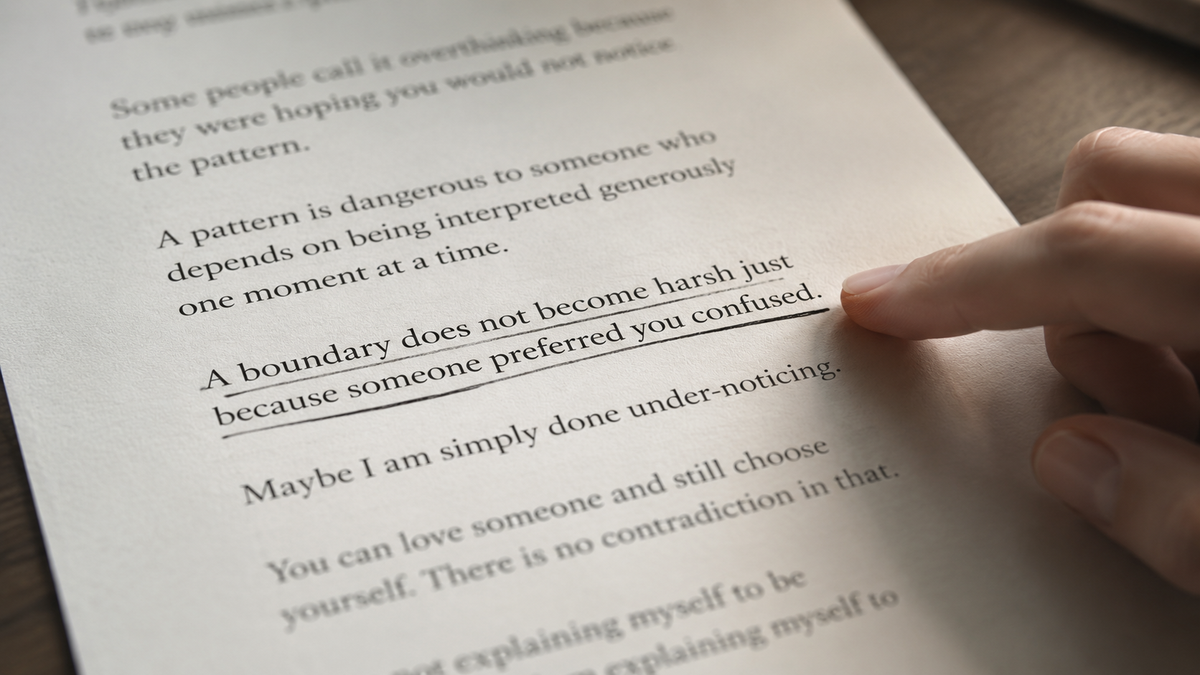
A boundary does not become harsh just because someone preferred you confused. It does not become unfair because it is based on repetition instead of one catastrophic event. We have a strange habit of waiting for something undeniable before we allow ourselves to act. We wait for the obvious betrayal, the dramatic rupture, the clean evidence nobody could dispute. But most dynamics that drain you do not announce themselves with theatrical cruelty. They arrive as small recurrences. A little dismissal. A little disappearing. A little inconsistency. A little tenderness at exactly the moment it becomes useful. A little correction of your memory. A little punishment for asking.
By the time you can explain it perfectly, you are often already exhausted.
That is why I trust timing. Timing tells the truth when words are too polished. Someone becomes attentive when you detach. Someone respects your boundary only after you stop explaining it. Someone apologizes after the consequence, not after the realization. Someone is warm when they want access, vague when accountability appears, wounded when you name the obvious, suddenly careful when distance becomes real. None of those things, alone, have to mean everything. Together, they begin to speak.
And when a pattern speaks, you are allowed to listen.
You do not have to call it a final verdict. You do not have to become cold, suspicious, unforgiving, or sealed away from the world. Pattern recognition is not a demand that you punish everyone who resembles someone who hurt you. It is not a command to treat fear as fact. It is simply protection. It is the part of you saying, this shape has a history. Please do not stand here unguarded and call it kindness.
I want softness that can survive being informed. I want tenderness that does not require me to forget. I want connection where memory is not treated like an enemy of peace. Because peace built on amnesia is not peace; it is compliance with better lighting. Real peace can tolerate the full story. Real repair can look at the sequence. Real intimacy does not ask you to become less perceptive so someone else can feel less exposed.
Some people confuse being understood with being attacked. If you name their pattern, they feel accused. If you remember accurately, they feel judged. If you ask why something keeps happening, they feel controlled. But clarity is not cruelty. Seeing a dynamic is not violence. Refusing to unsee it is not bitterness. A person who wants closeness has to tolerate being known beyond their preferred self-description. Otherwise, what they want is not intimacy. It is admiration with the lights dimmed.
This is why I am tired of “overthinking” being used as a blanket word for any thought that makes someone uncomfortable. Sometimes overthinking is real, and we should be honest about that. But sometimes the accusation is just a fog machine. Sometimes it is a way to make a woman doubt the intelligence that is trying to protect her. Sometimes it is a way to turn memory into a defect, sensitivity into drama, and pattern recognition into something embarrassing.
I am not interested in becoming easy by under-noticing. I am not interested in performing calmness as a form of self-abandonment. I do not want to be so reasonable that I keep offering fresh interpretations to behavior that has already introduced itself. I can be tender. I can be fair. I can hold complexity. But I will not keep shrinking my perception until the pattern looks accidental.
At some point, self-trust begins as a very quiet refusal. Not a performance, not a speech, not a dramatic exit. Just the decision to stop arguing yourself out of what you have seen. You may still check your interpretation. You may still ask whether fear is exaggerating. You may still choose generosity where generosity is deserved. But you stop treating your memory as a character flaw. You stop calling yourself difficult because clarity made someone defensive. You stop mistaking their discomfort with being noticed for proof that you noticed incorrectly.
Some people call it overthinking because they were hoping you would not notice the pattern. Maybe they were not even conscious of it. Maybe they needed the pattern to stay unnamed because naming it would require something from them. Maybe it would require change, accountability, honesty, or the loss of a version of you that was easier to manage. But whether they meant to or not, the effect is the same: you are asked to become less aware so the dynamic can remain more comfortable.
I do not think that is love. I do not think that is intimacy. I do not even think that is peace.
I think peace is what becomes possible after you stop negotiating with the part of you that knows. I think softness becomes safer when it has discernment. I think boundaries become cleaner when they are not forced to wait for damage dramatic enough to justify them. I think a person can be calm and still say, no, I have seen this before. I think a person can be kind and still refuse to separate the latest moment from the history that gave it meaning.
So no, I am not overthinking. Or maybe I am thinking more than someone hoped I would. Maybe I am remembering what was supposed to stay scattered. Maybe I am connecting what was easier to survive as fragments. Maybe I am no longer willing to confuse repeated discomfort with a series of unrelated misunderstandings.
Maybe I am simply done under-noticing.