The Quiet Violence of Being Made Less Visible
Not every erasure arrives as a ban. Sometimes it arrives as silence, lowered reach, invisible suspicion, and the slow training of a woman to soften herself.

The real victory of platform control is not deleting your post. It is teaching you to hesitate before writing it.
I started self-hosting because I got tired of being quietly erased. Not erased in a grand, cinematic, martyrdom-ready way. There was no dramatic exile, no single obvious moment I could frame and point at as proof. It was smaller than that, which somehow made it more exhausting. A post that did not travel. A profile that suddenly felt muffled. A piece of writing treated as if it had done something wrong, although nobody could clearly say what. A vague sense that the room had not thrown me out, exactly, but had adjusted the walls inward while smiling politely. That is the part people misunderstand about digital silencing. They imagine a ban hammer, a deleted account, a loud punishment, some public moment where the platform declares that you have crossed a line. Sometimes it is that. But often it is quieter, more deniable, more psychologically tiring. You are still technically allowed to speak, only your voice no longer carries. You are still technically present, only people stop finding you. You are still technically free, only every sentence begins to feel as if it has to pass through an invisible committee of machines, advertisers, anxious policies, vague cultural fears, and people who do not know the difference between discomfort and harm.
The language around these things is always so clean. Community standards. Safety. Trust. Integrity. Quality. All these polished, almost tender words, as if the whole system is only trying to protect the garden from weeds. But the result is not clean at all. The result is that a person learns to edit herself before anyone even asks her to. A woman learns to lower her voice not because she has been proven dangerous, but because the room keeps reacting as if her honesty has become inconvenient. And after a while, that inconvenience becomes a kind of discipline. You begin to hear the platform inside your own head. You begin to soften the sentence before you publish it. You begin to remove the part that is too bodily, too angry, too intimate, too sharp, too politically uncomfortable, too difficult to place beside an advertisement. You begin to ask yourself not only whether something is true, but whether it is safe enough for the room. That question may sound reasonable, but it slowly becomes corrosive, because the room is not neutral. The room has owners.
Meta did not surprise me much. I think part of me expected it there. Meta has always felt like a shopping mall pretending to be a town square. You can meet people there, yes. You can build habits there. You can even feel nostalgic there in a strange and embarrassing way, because human beings are very capable of forming emotional attachments to places that were never built for their freedom. But you are still inside someone else’s commercial architecture, and every wall is listening. Every gesture is measured. Every feeling is converted into a behavioral signal. So when that kind of place becomes unfriendly to complicated speech, I am not shocked. Annoyed, yes. Tired, yes. But not shocked. Substack hurt differently because I had imagined it as a place for complicated voices. I thought it was a place for intimate essays, strange confessions, political discomfort, erotic intelligence, grief, rebellion, tenderness, contradiction. I thought it would know the difference between harm and honesty. I thought it would understand that not every sharp sentence is a weapon, and not every uncomfortable thought is a threat.
Maybe that was naïve. Maybe every platform, once it becomes large enough, eventually becomes afraid of the very people who made it interesting. The writers arrive first, with their weirdness and hunger and impossible little voices. Then the platform grows around them. Then the money comes. Then the fear comes. Then the rules become smoother, colder, more ambiguous. Eventually the same place that once invited people to speak begins asking them to become more convenient. And the thing is, I was not publishing anything illegal. I was not trying to break laws, invite chaos, or turn the internet into a burning house. I was writing from inside my life, my body, my opinions, my disappointments, my hunger for freedom. My problem was never that I needed a place to hide something criminal. My problem was that I needed a place where being openly human would not be treated as a liability.
That is a very different problem, because when people hear “platform moderation,” they often imagine the extremes. They imagine obvious abuse, obvious harm, obvious illegality, the kind of content almost everyone agrees should be removed. But most of the real anxiety lives in the middle: in the ambiguous, bodily, political, emotional, feminist, personal, angry, sensual, wounded, intelligent middle. The place where a sentence is not illegal, not hateful, not dangerous, but still somehow too much for the platform’s nervous system. Too female. Too direct. Too embodied. Too political. Too difficult to categorize. Too intimate without being marketably inspirational. Too angry without being easily packaged as empowerment. Too alive. And complicated things are often treated as risk.
After a while, I started feeling that many big platforms are not nearly as liberal as they pretend to be. Or maybe they are liberal only in the decorative sense: liberal as long as your voice remains useful, clean, digestible, moderate enough to sit nicely beside the furniture. Liberal as an aesthetic. Liberal as brand language. Liberal as a rainbow graphic in June and silence in July. Liberal until the voice becomes too bodily, too sexually honest, too politically inconvenient, too emotionally unruly, too unwilling to perform gratitude for permission. Then something changes. The room narrows. The air thins. You begin to understand that openness has terms and conditions.
I felt that on my own skin. Not as theory, not as discourse, not as some abstract complaint about “the algorithm,” but in the small humiliations of trying to publish without knowing which part of myself had become suspicious. I felt it in the strange discipline of checking my own language too many times. I felt it in that ugly little hesitation before posting something honest, the moment where you wonder whether this will be punished, buried, quietly limited, misunderstood by a machine, or turned into another reason to make you smaller. At some point, that hesitation becomes the platform’s real victory. Not the deleted post. Not the warning. Not the restriction. The victory is when you start carrying the moderation system inside your own chest.
So I went looking for other doors. For weeks, I tested almost everything I could find: platforms, protocols, hosting options, themes, admin panels, tiny apps, strange experiments, promising tools, beautiful dead ends. I made accounts I might never use again. I compared features no normal person should compare at midnight. I read documentation with tired eyes. I broke things. I fixed things. I got excited by something for three hours and abandoned it the next morning because the maintenance burden already felt like a future resentment. I installed, uninstalled, tested, cursed, refreshed, rebuilt, redirected, mapped domains, checked ports, stared at blank pages, celebrated tiny victories that would sound completely ridiculous to anyone outside this particular madness. It was not graceful. It was not romantic. It was not some poetic montage of a woman reclaiming her voice through technology while soft music plays in the background. Sometimes it was boring. Sometimes it was infuriating. Sometimes it was lonely in that very specific way technical problems can be lonely, because the machine does not care that the problem is also emotional. A server error does not know it is standing between you and your dignity. A broken configuration file does not know it has become the latest gatekeeper between your voice and the world.
Underneath all of it, though, there was one simple question: where can my voice live without asking permission to breathe? Once you ask that seriously, you stop seeing platforms as neutral places. You start seeing them as rooms with landlords. You start noticing who owns the walls, who controls the locks, who can change the lighting, who decides whether your table is still allowed to stand where you put it. You start noticing how much of modern creativity depends on renting emotional space inside systems that do not love us back. And I am tired of paying rent on my own voice. I am tired of being told that visibility is a privilege granted by companies that profit from human expression. I am tired of watching people build years of thought, audience, memory, identity, and creative continuity on platforms that can shift beneath them overnight. I am tired of the fragile little bargain where we are allowed to be ourselves only as long as ourselves remain profitable, unthreatening, classifiable, and easy to serve to others in a feed.
Convenience made this feel normal, and that is the dangerous part. It is convenient to publish where everyone already is. It is convenient to outsource the difficult parts. It is convenient to let the platform handle the hosting, the design, the discovery, the subscription layer, the social graph, the archive, the identity, the memory. It is convenient until the convenience becomes dependency. Then one day you realize you have not built a home. You have decorated a rented room, and the landlord does not remember your name. This does not mean convenience is evil, or that everyone needs to self-host everything, or that using platforms is some moral failure. That would be absurd. Tools exist because people need tools, and not everyone wants their creative life to involve servers, tunnels, ports, backups, and the occasional feeling that technology was invented specifically to test your emotional regulation. But there is a difference between using a platform and being psychologically owned by it. There is a difference between distributing your work through rented rooms and believing those rented rooms are the only proof that your work is real.
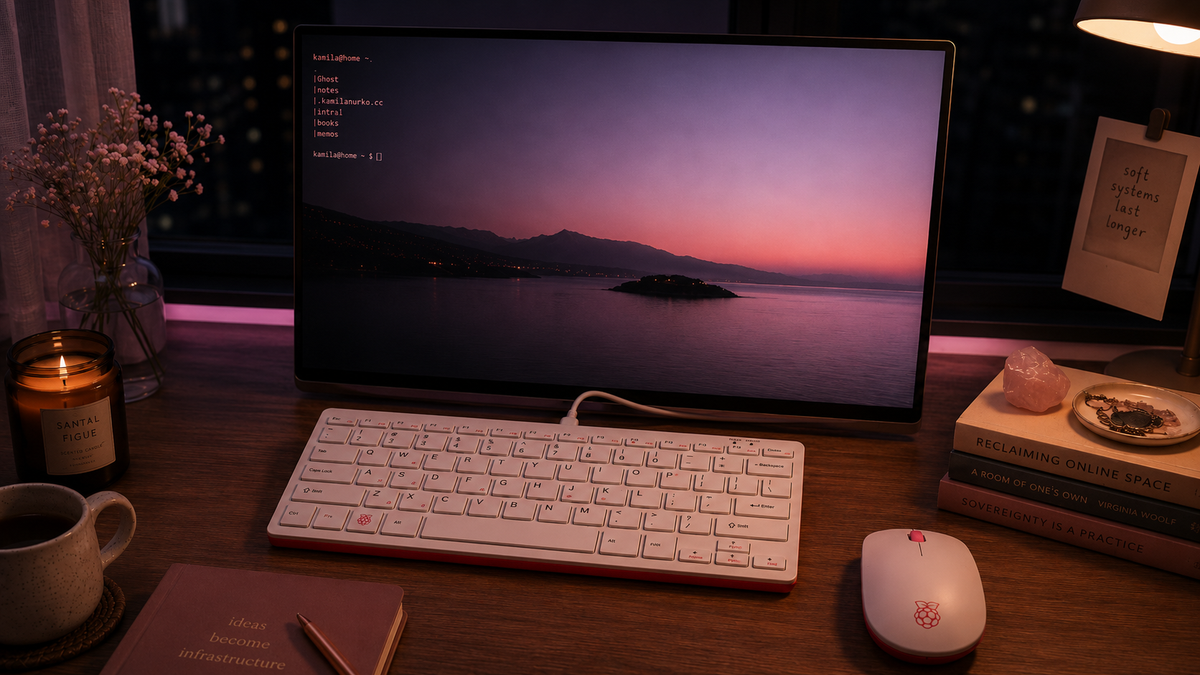
Right now, my answer is imperfect but real. My main blog lives on Ghost, self-hosted, under my own control, on my own domain. That matters to me more than I expected it to. Not because Ghost is perfect. I do not believe in perfect platforms anymore; perfection is usually just a word people use before the first serious disappointment. But Ghost gives me something important: a primary home, a place with a stronger spine, a place where the work can accumulate without being psychologically dependent on the mood of a feed. There are subscribers there, and that matters too. Not as numbers, not as a vanity metric, not as a little dopamine altar where I go to measure whether I am still real, but because those are people who have chosen to receive my words. That is a different relationship from being randomly surfaced, randomly buried, randomly rewarded, randomly punished. A subscriber is not just traffic. A subscriber is a small act of return. Someone has said, quietly: yes, I want this voice to reach me again.
I have already built something there, however modestly: a table, a lamp, a place where the same readers can come back. Maybe that sounds sentimental, but I do not think it is sentimental at all. I think it is practical. Writing needs continuity. A voice needs somewhere to gather itself. Not every thought should be thrown into the river of a feed and judged by how quickly it floats past strangers. Some writing needs a house. Some writing needs walls. Some writing needs an archive, a door, a familiar corner, a sense that it will still be findable after the algorithm has forgotten its little fever. That is what Ghost gives me right now: a home base, not a prison, not a final answer, not the one sacred platform above all others, but a center of gravity.
The language versions live elsewhere where they make sense. Some of that is happening in the AT Protocol world, in Atmosphere, in this strange blooming ecosystem of apps and experiments that still feels unfinished in a way I actually like. Not finished enough to become arrogant. Not polished enough to be dead. There is still weirdness there. There is still the feeling that people are building doors before anyone has fully agreed on the shape of the house. Some of these apps will disappear. Some will become briefly beloved and then vanish into screenshots and nostalgia. Some will probably become too aesthetic to be useful. Some will be useful but too clumsy to seduce normal people. That is how new ecosystems behave at first. They arrive feverish, overconfident, half-built, full of promises and bugs and people declaring futures before the floor is even stable. Still, I can feel where there is a pulse.
There are tools that have that early electricity. Not hype exactly, because hype is usually too loud, too marketing-shaped, too pleased with itself. This is something quieter and more interesting: possibility. A sense that people are not only trying to capture attention, but trying to create space. Different kinds of space: social space, publishing space, identity space, protocol space. Space where the account is not the same thing as the platform. Space where a domain can mean something again. Space where identity can become more portable, less trapped, less easy to confiscate. And I want space. Not endless novelty. Not another shiny place to scatter myself. Not ten more accounts with ten more bios and ten more little graves of abandoned enthusiasm. I want space with purpose, a little more air around the work, a little more dignity around the act of publishing, a little less dependence on companies that can change the weather overnight and expect us to call it climate.
That is why I am curious about these new apps, not because I want to live everywhere. Being everywhere is not sovereignty; sometimes it is just fragmentation with better branding. I do not want my identity split into so many rooms that no room knows who I am anymore. I want each place to have a function. Ghost is the home for the serious essays, the darker architecture, the primary long-form writing. Bluesky can be the signal flare, the conversational edge, the place where a thought becomes visible enough to find its people. Visual platforms can hold atmosphere, texture, light, presence. AT apps can become experiments, language rooms, distribution layers, strange little annexes of the house. But the house still needs a spine, and for me, the domain is the spine.
That realization feels almost old-fashioned now, which is funny because the internet was supposed to make domains obvious. But for a while, many of us forgot. We let platforms convince us that a profile was a home. We let feeds replace archives. We let handles become identity. We let discoverability become a substitute for continuity. We let the big rooms become so loud that owning a quiet door started to feel unnecessary. A domain is different. A domain says: this is not only where I happen to be posting today; this is where you can find me when the furniture burns. This is the address that survives platform moods, interface redesigns, moderation panic, product pivots, acquisitions, cultural shifts, and whatever new vocabulary Silicon Valley invents to explain why your dependency should feel empowering.
A domain is not magic. It still needs maintenance, money, attention, renewal, protection. It is not outside capitalism and it is not outside infrastructure. But it gives back a small and meaningful piece of control. It lets you build continuity somewhere less psychologically fragile than a profile page owned by a company that can decide tomorrow that your kind of voice is bad for the vibe. That matters especially if your writing touches things that platforms are bad at holding: desire, anger, politics, grief, bodily truth, female autonomy, intimate contradiction, refusal. The big platforms like bodies when bodies are profitable. They like women when women are decorative. They like vulnerability when vulnerability becomes engagement. They like political speech when it remains safely branded. They like empowerment when it can be sold as a mood board. But a woman thinking out loud in her own register, not performing softness on command, not sanding down every edge, not offering her body or her pain in the approved format, becomes more complicated. And complicated things are often treated as risk.
I do not want nuance flattened into suspicion. I do not want desire, politics, intimacy, grief, female anger, or bodily freedom treated like stains that need to be scrubbed away before the advertisers arrive. I do not want every essay to depend on the mood of an algorithm, or every sharp paragraph to feel like it has to survive a purity test written by people who confuse discomfort with harm. I do not want to become so well-behaved that my own writing no longer recognizes me. I want my writing to have a home. That may sound sentimental, but to me it feels almost domestic, like choosing where the morning light should fall, deciding which corner will hold the books, refusing to sleep in someone else’s hallway and call it shelter. There is a reason the language of home keeps returning when I think about this. Writing is not only output. It is not only content. It is not a unit of productivity or a brand asset floating in an engagement funnel. It is a living practice, and living practices need somewhere to live.
Self-hosting, for me, is emotional architecture. It is a way of touching the walls and knowing they are mine, even when the paint is uneven. Especially then. The imperfections matter. The slightly ugly admin panel matters. The strange little configuration choices matter. The fact that I know where something is running matters. The fact that I can break it and repair it matters. The fact that the site is not just an account but a thing with structure, a thing with a machine under it, a thing I can understand more deeply if I choose to, gives the whole act of publishing a different weight. I do not mean that everyone should do this. I know not everyone wants to spend their free time learning why something refuses to load. I know not everyone gets a strange thrill from seeing a service finally respond after an hour of being stubborn. I know not everyone wants the technical responsibility, and I do not think independence should become another purity culture where people shame each other for not hand-building every piece of their digital lives. That would be ridiculous. But for me, in this moment, after feeling how fragile platform permission can be, I needed something else. I needed to understand the structure that holds my voice. I needed to know that if one room became hostile, there was another room I had not merely rented but built. I needed to stop treating my own writing as luggage that could be misplaced by someone else’s system.
The setup can be annoying. The maintenance can be lonely. Sometimes freedom looks like a server error and a cup of coffee gone cold beside my laptop. Sometimes independence is not glamorous at all. Sometimes it is just me, tired, reading documentation that seems to have been written by and for people who do not believe emotions exist. Sometimes it is fixing something tiny that no reader will ever notice. Sometimes it is realizing that the romantic fantasy of digital sovereignty has a very unromantic backend. But there is dignity in it. There is dignity in learning the structure that holds your voice. There is dignity in not handing everything over because convenience has made obedience feel normal. There is dignity in building something imperfect and still saying: this is mine. There is dignity in refusing to let your work exist only where it is easiest to monetize, categorize, recommend, suppress, or forget.
Maybe this is the part that matters most: self-hosting changed my relationship to publishing. It made the act feel less like asking to be let into a room and more like opening a door I installed myself. It made me less desperate for platform approval because the work no longer depends on a single gate. It made experimentation feel lighter. If an AT app works, beautiful. If it disappears, fine. If a social platform sends people to the essay, wonderful. If it does not, the essay still exists. The center holds somewhere else. That is the freedom I wanted. Not total independence, because total independence is mostly a fantasy. We all depend on something: servers, DNS, protocols, communities, readers, tools, electricity, time, money, attention. But there is a difference between interdependence and captivity.
I am trying to remember that difference. I know the internet will keep changing. I know every platform that feels open today can become gated tomorrow. I know every promising tool can be bought, broken, abandoned, overrun, underfunded, misunderstood, or slowly made hostile to the very people who gave it life. I know open ecosystems can become messy. I know self-hosted systems can become maintenance traps. I know decentralization can sound beautiful in theory and then become a confusing pile of half-compatible realities in practice. I am not naïve about digital spaces anymore. But I also refuse to become bitter, because bitterness is just another way of letting them make me smaller. It is still a reaction to the room that hurt you. It is still a kind of dependency. I do not want to spend my creative life only documenting the failures of platforms that never deserved that much of my imagination. I can critique them, learn from them, name what happened, but I do not want resentment to become the house I build next.
I want something more interesting than resentment. I want infrastructure with a pulse. I want a writing system that lets the work mature instead of panic. I want platforms to become tools again, not emotional authorities. I want my voice to move through different rooms without being shattered by them. I want Ghost to hold the essays that need a spine. I want other spaces to hold language, conversation, images, fragments, experiments. I want the whole thing to feel less like chasing visibility and more like building continuity. Because that is what I think so many of us are actually hungry for now: continuity. Not virality, not constant exposure, not the exhausting performance of being everywhere at once, but continuity. The feeling that the work we make today will still belong to us tomorrow. The feeling that our archives are not hostages. The feeling that our readers can find us without needing to guess which platform currently tolerates us. The feeling that our identities are not rebuilt from scratch every time an app rises or falls.
That is what I am building toward, slowly and imperfectly, sometimes stubbornly, sometimes with more tabs open than dignity should allow. And one thing is certain: I will not stop writing. Actually, I might write more, which is maybe the part that makes me smile. Every attempt to make writing harder only seems to make the words more stubborn. They come back with dirt under their nails. They come back tired, irritated, alive. They come back less interested in pleasing the room. Writing has never been only content for me. It is not a funnel, not a brand strategy, not a machine I feed so it can produce relevance. Writing is how I gather myself after the world has tried to scatter me. It is how I understand what I believe after everyone else has spoken too loudly. It is how I return to my body. It is how I find the shape of my refusal.
And also, simply, I like it. I like writing. I like the pressure before a sentence opens. I like the small private click of finding the right word. I like the discipline of following a thought past its first emotional version into something clearer, stranger, more honest. I like the quiet after publishing, when something that lived only inside me becomes a room someone else can enter. I like that writing keeps asking me to be more precise than my mood, more honest than my fear, less obedient than my training. I like that writing does not let me disappear from myself. So I will keep my Ghost blog. I will keep the language versions where they make sense. I will keep exploring the AT world with curiosity and caution. I will test the doors. Some will open into nothing. Some will open into rooms full of people I did not know I was looking for. Some will become part of the house. Some will simply teach me what kind of house I refuse to live in.
But I am done treating my voice like a guest. It is not a guest. It lives with me. And wherever that home has to be built, moved, mirrored, translated, hosted, repaired, protected, or carried by hand, I will do it. Not because I enjoy technical struggle for its own sake, not because I want independence to become another form of isolation, not because I think self-hosting makes me morally superior to anyone who uses ordinary platforms and sleeps peacefully at night. I will do it because my writing deserves somewhere to stand without apologizing for its own pulse. I am not finished. Not even close. I am only learning where to plant the roots.