It Was Never the Skirt
Rape survived modesty, long dresses, petticoats, church clothes, marriage vows, family reputations, and every era that pretended women could dress their way into safety.

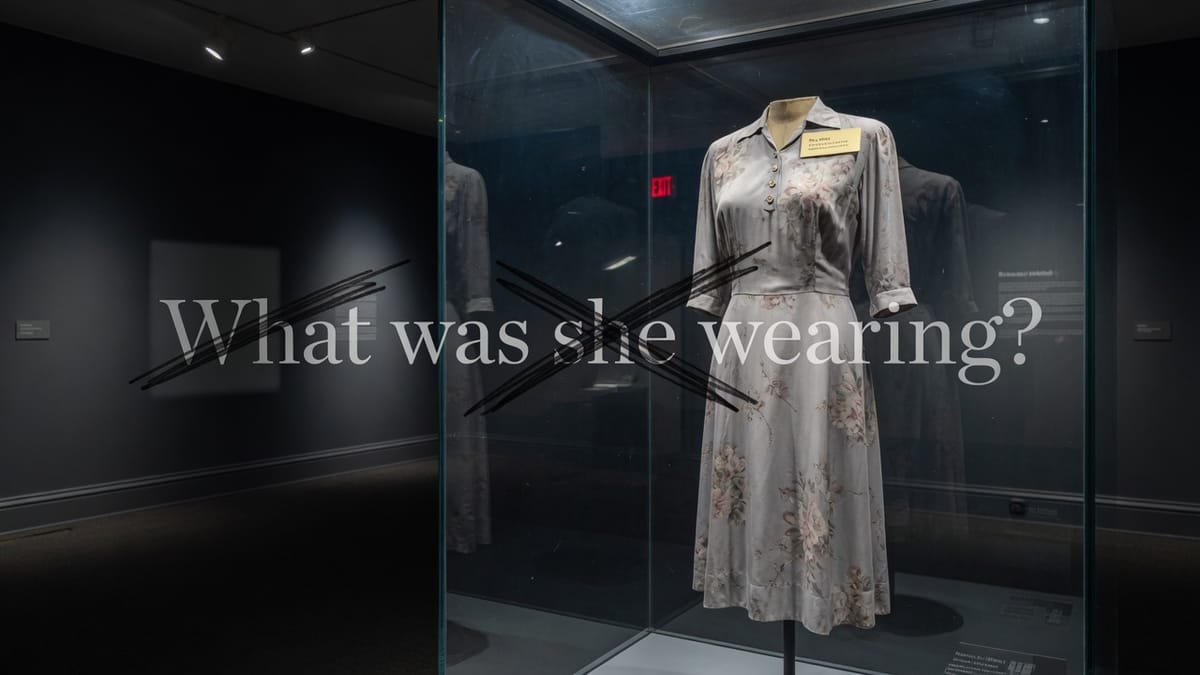
A woman’s clothes are not a confession. Her body is not public property. And a rapist is not a victim of fashion.
There is a very old lie that keeps returning every time sexual violence is discussed. It does not always arrive as open cruelty. Sometimes it comes dressed as advice, sometimes as concern, sometimes as tradition, sometimes as religion, sometimes as “realism,” and sometimes as that exhausted little sentence people use when they want to sound practical instead of cowardly: well, women should also be careful what they wear.
It is an old sentence because it is useful. Not useful to women, obviously. It has never made women safe. But it is useful to everyone who wants to move the center of the conversation away from the person who chose violence and toward the person who survived it. It gives people something visible to judge. A skirt. A neckline. A photograph. A party dress. A pair of heels. A bikini. A body. Something easier to discuss than entitlement, power, consent, coercion, misogyny, impunity, family silence, institutional cowardice, and the uncomfortable fact that many perpetrators are not monsters hiding in alleys but ordinary men with names, friends, jobs, reputations, and people willing to explain them away.
The lie says that rape happens because women are too visible, too free, too sexual, too careless, too drunk, too pretty, too trusting, too modern, too available, too much. It says that if women covered themselves differently, moved differently, smiled less, drank less, stayed home more, chose better, resisted harder, screamed louder, reported faster, remembered more clearly, behaved more perfectly, then perhaps violence would finally stop.
But history destroys that fantasy.
Rape existed when women wore skirts below the knee. It existed in the 1950s, under neat dresses, folded collars, gloves, stockings, aprons, church clothes, and the supposedly respectable femininity that some people now romanticize as if modesty used to protect women from male violence. Rape existed in the 19th century, when women wore long dresses and layers of clothing, when the female body was far less publicly visible and far more socially controlled. It existed under corsets, petticoats, veils, uniforms, wedding dresses, mourning clothes, and every textile arrangement that moralists still pretend could have saved us.
If modesty prevented rape, history would look very different. It does not.
That should be enough to end the argument, but of course it never is, because the argument was never really about logic. It was about control. The demand that women dress “properly” is not a serious theory of crime prevention. It is a cultural habit of making women responsible for managing men’s behavior. It asks women to live as if male violence is weather: inevitable, natural, unpredictable, and somehow their fault if they failed to carry the correct umbrella.
But rape is not weather. It is not chemistry. It is not a neckline accidentally triggering biology. It is not a skirt overpowering a moral compass. It is not desire becoming so intense that ethics disappear. Men are not helpless animals dragged through the world by their bodies. They control themselves in offices, airports, courtrooms, churches, police stations, family dinners, job interviews, and in front of people whose power they respect. They understand consequences perfectly well when consequences are real. They understand boundaries perfectly well when the boundary belongs to someone they cannot safely violate.
So no, rape does not happen because a woman is dressed provocatively. It happens because someone decides his desire, anger, entitlement, humiliation, curiosity, opportunity, or need for power matters more than another person’s consent. Sometimes people call this “not being able to control himself,” but even that phrase is too generous. It makes the perpetrator sound like a victim of instinct, as if his body committed the crime while his character stood nearby helplessly. The more honest version is uglier: he did not lack control; he gave himself permission.
And that is the part society keeps trying to soften. It is more comfortable to imagine rape as a tragic overflow of sexual need than as a deliberate violation of personhood. It is easier to say “men are visual” than to say some men have been taught, directly or indirectly, that women’s boundaries are negotiable if desire is strong enough. It is easier to say “she should not have worn that” than to say “he should not have thought access was his to take.” It is easier to turn female clothing into evidence than to examine the culture that keeps confusing male arousal with entitlement.
The whole “what was she wearing?” question only survives because people pretend clothing is a language more powerful than consent. They behave as if a short skirt can say yes even when a woman says no, as if cleavage can sign a contract, as if beauty cancels refusal, as if a woman can accidentally dress herself out of human rights. This is absurd when said plainly, which is why victim-blaming rarely says itself plainly. It hides behind warnings. It speaks in lowered voices. It calls itself common sense. It says, “I’m not blaming her, but…” and then proceeds to blame her with the full confidence of a society that has practiced this ritual for centuries.
The word provocative is especially revealing because it has never had a stable meaning. Almost anything a woman does can become provocative if someone wants to blame her for the reaction of others. Hair has been provocative. Ankles have been provocative. Bare shoulders have been provocative. Red lipstick has been provocative. Dancing has been provocative. Laughing too loudly has been provocative. Walking alone has been provocative. Being young has been provocative. Being beautiful has been provocative. Being independent has been provocative. Wanting sex has been provocative, but refusing sex has also been provocative, because some men experience rejection itself as an insult.
That is how you know the rule is fake. When the target keeps moving, the real target is not safety. It is obedience.
And even obedience does not protect women. That is the cruelest part. A woman can do everything the culture told her to do and still be harmed, then questioned, doubted, dissected, and quietly blamed. If she was covered, people ask why she was alone. If she was not alone, they ask why she trusted him. If she knew him, they ask why she went there. If she did not know him, they ask why she was outside. If she drank, they call her careless. If she was sober, they ask why she did not escape. If she froze, they ask why she did not fight. If she fought, they ask why there are not enough marks. If she speaks quickly, she is dramatic. If she waits, she is suspicious. If she cries, she is unstable. If she does not cry, she is cold. If she remembers details, she rehearsed it. If trauma blurred the details, she is unreliable.
This is not a search for truth. It is a ritual of disbelief.
The perfect victim does not exist because the perfect victim is not a person. She is a fantasy invented by people who want survivors to be innocent in a way that costs society nothing. She must be modest but not prudish, hurt but not messy, credible but not angry, traumatized but not inconvenient, brave but not loud, damaged but not too damaged, pure but not childish, respectable but not boring, and grateful for whatever little sympathy is offered to her after everyone finishes auditing her life.
Meanwhile, the perpetrator is often allowed to remain complicated. He was drunk. He was confused. He misunderstood. He was young. He was lonely. He was from another generation. He had a future. He had a family. He had talent. He had stress. He had a reputation. He had people who could not imagine him doing something like that, which often only means they cannot imagine themselves having loved, admired, hired, defended, or raised someone capable of it.
So the woman becomes a case file, and the man becomes a tragedy.
That reversal is one of the ugliest achievements of rape culture.
Rape culture does not mean that everyone openly supports rape. It means the surrounding culture makes sexual violence easier to excuse, easier to minimize, easier to joke about, easier to disbelieve, easier to survive publicly only if the survivor fits a narrow aesthetic of innocence. It is in the friend group that knows exactly which man is unsafe but still invites him everywhere. It is in the family that protects the respectable name. It is in the institution that worries about reputation before harm. It is in the comment section that treats a survivor’s photo like forensic evidence. It is in the courtroom question that makes clothing sound relevant. It is in the phrase “boys will be boys,” which manages to insult boys, excuse men, and endanger women at the same time.
The clothing argument also collapses because rape is not only committed against women who are considered beautiful, fashionable, sexual, or publicly desirable. Children are raped. Elderly women are raped. Disabled people are raped. Men and boys are raped. Women in religious dress are raped. Women in uniforms are raped. Women in hospitals, prisons, homes, schools, marriages, workplaces, and war zones are raped. People are assaulted while asleep, unconscious, dependent, frightened, trapped, manipulated, threatened, or too shocked to move. None of that fits the myth that rape is a reaction to provocative fashion, so the myth simply ignores the evidence.
That is why it is so important to say this clearly: rape is not caused by beauty. It is not caused by ugliness. It is not caused by youth, age, race, class, personality, sexuality, intoxication, trust, flirtation, or the amount of skin visible in a room. These things may affect how a perpetrator chooses a target, how society responds, how much the survivor is believed, or how the violence is later rationalized, but they do not cause rape. The cause is the person who violates consent. Everything else is a distraction built around the refusal to place responsibility where it belongs.
And no, acknowledging this does not mean people should never talk about risk. Of course risk exists. Women know this better than anyone because women are trained from childhood to calculate danger. Women text each other when they get home. Women hold keys between their fingers. Women pretend to be on phone calls. Women soften rejection because angering a man can be dangerous. Women monitor drinks, exits, streets, elevators, hotel corridors, taxis, parking lots, parties, dates, bosses, relatives, friends, and strangers. Women learn to read a room with the precision of someone whose safety may depend on it.
Women already know about caution. They have been living inside caution for centuries.
The problem is that society keeps mistaking women’s caution for men’s innocence. Safety advice can be practical before harm happens, but after harm happens it must not be turned into a weapon. Telling someone to lock a door does not make burglary their fault if someone breaks in. Telling someone to wear a seatbelt does not make a drunk driver innocent. Telling women to be careful does not transfer moral responsibility from the perpetrator to the survivor. Risk reduction is not blame. The difference matters, because victim-blaming loves to disguise itself as prevention.
There is also something deeply dishonest in the way people treat male desire as both sacred and uncontrollable. When men want women, women are told to be flattered, careful, modest, available, unavailable, soft, defensive, forgiving, and responsible for the emotional weather of rejection. But desire is not an emergency. Attraction does not create rights. Arousal does not erase another person’s humanity. Healthy desire can tolerate the word no. Healthy sexuality does not require pressure, fear, intoxication, confusion, silence, dependency, or exhaustion. Healthy masculinity does not collapse because a woman is beautiful and unavailable.
The idea that a woman’s clothing can make a man unable to control himself is not just dangerous to women; it is insulting to men. It describes men as creatures too weak to exist around fabric and skin without becoming violent. It lowers the moral expectations for men so far that basic decency starts to look like heroism. And yet we know this is not true. Men can control themselves. Most do. The issue is not biology. The issue is which men believe they are entitled to stop controlling themselves when the person in front of them has less power, less protection, or less chance of being believed.
That is the part modesty culture does not want to discuss. A long skirt can be blamed, a short skirt can be blamed, alcohol can be blamed, nightlife can be blamed, but entitlement is harder to confront because entitlement often lives close to home. It lives in the husband who believes marriage means permanent access. It lives in the boyfriend who treats persistence as romance. It lives in the boss who understands dependency too well. It lives in the friend who pushes boundaries and laughs when women look uncomfortable. It lives in the respected man whom everyone protects because admitting the truth would be socially expensive.
This is why many people prefer the stranger-in-the-alley myth. It makes rape feel external, exceptional, monstrous, and far away. It allows families, institutions, and friend groups to imagine themselves innocent. But sexual violence is often intimate, familiar, socially inconvenient. It often happens where trust already exists or where power already has a structure. The perpetrator may not need a dark street; he may need a closed door, a reputation, a hierarchy, a victim who doubts herself, and a community more comfortable with silence than accountability.
That is not uncontrollable lust. That is opportunity meeting permission.
And sometimes the permission comes not only from the perpetrator, but from the world around him. Not explicit permission, perhaps. Not someone saying, “Go ahead.” But the softer permission of jokes, excuses, lowered standards, weak consequences, disbelief, and the constant training women receive to manage men rather than expect better from them. Every time a boundary-pushing man is described as harmless, every time a survivor is asked what she did to cause the violence, every time reputation is protected before safety, the culture teaches a lesson. Some men hear it very clearly.
This is why the solution cannot be another dress code for women. Women have already lived through every dress code. They have been covered, controlled, supervised, married off, locked away, shamed, watched, and told that purity would protect them. It did not. The solution is not to make women smaller. It is to make consent non-negotiable. It is to raise boys without teaching them that persistence is proof of masculinity. It is to teach desire without entitlement, attraction without ownership, rejection without humiliation, and sexuality without conquest. It is to make consequences real enough that charm, status, talent, age, alcohol, and “good family” stop functioning as shields.
It also means changing what we ask first. Not “what was she wearing?” but “what did he do?” Not “why did she go there?” but “why did he treat her presence as permission?” Not “why did she drink?” but “why did he see impairment as opportunity?” Not “why did she not fight?” but “why was refusal not enough?” Not “why did she wait to speak?” but “what kind of world makes speaking so costly?”
Those questions move the light back where it belongs.
And maybe that is why some people hate them. Once the light moves, innocence becomes harder to perform. The friend group has to admit what it ignored. The family has to admit what it protected. The institution has to admit what it sacrificed. The man who says “not all men” has to ask why his first instinct was self-defense instead of solidarity. The woman who says “I would never put myself in that situation” has to grieve the comforting illusion that correct behavior guarantees safety. The culture has to admit that women were never in danger because they failed to dress properly. They were in danger because too many people found it easier to regulate women than confront men.
There is no fabric in the world that can turn violence into consent. A dress is not an invitation. A body is not a public resource. Beauty is not a contract. Flirtation is not a signature. Marriage is not permanent permission. Drunkenness is not consent. Silence is not consent. Fear is not consent. Freezing is not consent. A past yes is not consent forever. A woman’s reputation is not evidence. Her sexuality is not a waiver. Her survival response is not a performance to be graded by strangers.
And a rapist is not a victim of fashion.
That is the sentence underneath everything. The whole myth of clothing is built to avoid it. It tries to turn the survivor’s body into the explanation because the alternative is admitting something much more threatening: the problem is not women’s freedom, women’s fashion, women’s beauty, women’s sexuality, or women’s presence in public. The problem is the person who decides another human being’s body can be taken, pressured, coerced, used, or violated.
Once we admit that, the demand changes. We stop asking women to dress like possible victims and start asking why so many men are allowed to move through the world with their entitlement unexamined. We stop teaching girls that safety means disappearing and start teaching boys that desire is not a legal argument. We stop treating female caution as the price of civilization and start treating male accountability as the minimum condition for one.
The old fact remains, simple and devastating: rape existed under long dresses. It existed under layers. It existed in eras of modesty, silence, obedience, marriage, religion, and respectability. It existed when women had fewer choices, fewer rights, fewer public lives, and far less freedom. If clothing were the cause, modest history would have been safe. It was not.
So the next time someone asks what she was wearing, the answer is: irrelevant.
The relevant question is not how short the skirt was. The relevant question is why someone believed consent could be ignored. The evidence is not in the fabric. It is in the violation. And the responsibility does not belong to the woman who had a body in the world. It belongs to the person who decided that body was his to use.
Because it was never the skirt.
It was always the entitlement.