Realness Is Not a Tone. It Is a Trail.
In a culture that can imitate sincerity beautifully, I no longer trust the performance of authenticity. I trust memory, boundaries, and what remains over time.


The internet loves a woman’s authenticity when it can consume it. It becomes less comfortable when her authenticity includes refusal, privacy, silence, and control over the terms of being seen. But those things are not failures of intimacy. Sometimes they are where the truth is being protected.
There was a time when authenticity still felt like a useful word. It meant something simple enough to trust: a person sounding like herself, a room looking lived in, a sentence arriving with a pulse instead of a strategy. It meant the relief of something not polished into submission. A bad angle, a slightly awkward phrase, a thought that had not yet been coached into usefulness. The roughness made it believable because it seemed to come from life rather than from production, and maybe that was naive, but it was a useful kind of naive. We needed some way to recognize the human under all the surfaces.
Then authenticity learned how to pose. Now realness has a costume. It has lighting, pacing, a caption style, a controlled amount of mess in the frame. It knows how to sound unfiltered without risking too much. It knows how to begin with “I wasn’t going to share this” while sharing exactly well enough. It knows how to be vulnerable in a brand-safe way, intimate without being dangerous, imperfect with excellent composition. Even the refusal of polish has become polished. Even the rejection of performance can now perform itself beautifully.
The problem is not that everyone is fake. That would be too easy, and also too flattering to the person saying it. The deeper problem is that the signs we used to associate with sincerity have become easy to imitate. Messiness can be arranged. Vulnerability can be formatted. Softness can be generated. A trembling sentence can be written on purpose. A confession can be edited until it looks spontaneous. The internet has not only learned how to perform beauty; it has learned how to perform relief from beauty. It has learned how to say, look, no mask, while wearing the most culturally current mask available.
That is why I no longer trust authenticity as a tone. I still believe in sincerity, maybe more than before. I still believe in the uneven rhythm of a person trying to say something true. I believe in awkwardness, contradiction, privacy, tenderness, irritation, softness, and the small human failures that make a voice feel inhabited. But I do not believe those things can be proven by aesthetic signals alone. A post can sound human and still be weightless. A caption can feel intimate and still be engineered. A voice can be warm and still have no responsibility behind it. Realness is not a tone. It is a trail.
This feels very 2026 to me, not because the problem is only artificial intelligence, but because the atmosphere has changed around what counts as proof. The synthetic does not only imitate what is glossy anymore. That would be easier to reject. It imitates warmth. It imitates hesitation. It imitates emotional intelligence. It imitates the little pauses and imperfect turns we used to trust because they seemed too inefficient to fake. It can produce a paragraph that sounds like someone sat alone at midnight and finally admitted the truth, even if no one risked anything to write it. That is not just a technical problem. It changes the emotional climate of the internet.
The older internet taught us to distrust perfection. The newer internet is teaching us to distrust performed imperfection, and honestly, that is more tiring. A badly lit image does not automatically mean honesty. A raw sentence does not automatically mean courage. A public wound does not automatically mean truth. Exposure is not evidence. Intensity is not evidence. Relatability is not evidence. Even vulnerability, which the internet often treats as the highest currency of being real, is not automatically evidence. A person can reveal a lot and still manipulate the frame. A person can cry and still avoid accountability. A person can confess and still be performing. And the reverse is also true: a person can reveal very little and still be deeply honest.
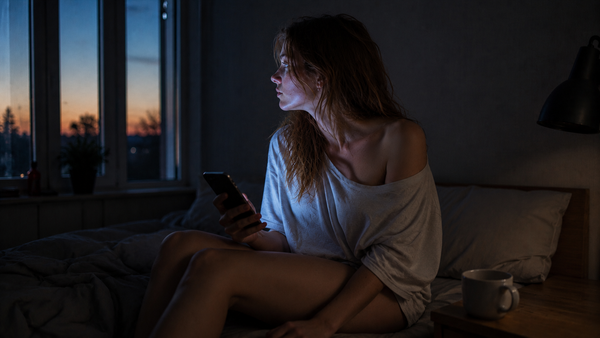
This is where privacy keeps being misunderstood. Privacy is often treated like suspicion, as if the person who protects something must be less real than the person who offers everything. But privacy is not the opposite of authenticity. Sometimes privacy is the condition that allows authenticity to survive. If every private thing has to become proof, the self is no longer protected. It becomes a resource, a mine, a content pillar, something extracted from itself again and again to reassure strangers that yes, there is a person here, yes, she feels, yes, she hurts, yes, she is real enough to keep watching. I do not want that bargain. I do not want to expose myself to prove I exist.
There has to be a way to be readable without being consumed. There has to be a way to build trust without placing the most delicate parts of life under public light. There has to be a way for a woman online to be visible without becoming available in every direction. This is where the demand for authenticity becomes gendered, even when nobody says so directly. Women are encouraged to be real, but in a form that remains pleasing. Be open, but not inconvenient. Be strong, but not hard. Be soft, but not sovereign. Be vulnerable, but do not make anyone feel implicated. Be intelligent, but not cold. Be beautiful, but not vain. Be private, but not mysterious enough to frustrate consumption. Be visible, but do not control the terms of visibility too tightly, or people will start calling it distance.
The internet loves a woman’s authenticity when it can consume it. It becomes less comfortable when her authenticity includes refusal. But refusal is part of the evidence. A boundary repeated over time tells me more about a person than a perfect confession. A silence held with intention tells me more than constant emotional availability. A body of work that does not beg to be understood by everyone tells me more than a hundred posts designed to feel instantly relatable. The parts of a person that are not offered for consumption are not necessarily less true. Sometimes they are where the truth is being protected.
That is why I have started caring less about whether something feels authentic in the moment and more about what it belongs to. Does this sentence belong to a body of work? Does this opinion have a history? Does this softness have boundaries? Does this public self have a private center it is not constantly selling? Does this voice remain recognizable when the platform changes what it rewards? Does this person have an archive, or only a mood? A single post can be convincing. A single post can arrive at the right time, with the right tone, and feel like proof. But a single post is also the easiest unit to manufacture. It can be generated, staged, optimized, emotionally sharpened, stripped of context, and sent into the room as if it carries a whole life behind it.
Continuity is harder. It requires time, which is exactly why it is less fashionable and more trustworthy. It requires returning to certain themes before they are fashionable, after they are fashionable, and when nobody is rewarding them at all. It requires being seen across phases. It requires the older sentence and the newer sentence to disagree in ways that still make sense. It requires a person to change without becoming unrecognizable to herself. That is a different kind of realness: not the dead consistency of a brand guideline, but the living consistency of a mind with memory. I do not need a person to be unchanged. I need their changes to have a trace.
That is the kind of authenticity I still trust. Not the kind that performs realness beautifully in a moment, but the kind that leaves evidence over time. Evidence is not as glamorous a word as authenticity. It does not glow as easily. It does not seduce as quickly. It does not flatter the reader by asking to be felt immediately. It is slower and less decorative. It is the archive, the repeated boundary, the old thought becoming clearer, the private principle that keeps showing up in public form. Evidence is what remains when the performance evaporates.
The feed is bad at this because the feed is almost designed to destroy context. It lifts a fragment away from its history and places it in front of strangers who are invited to react before they understand. It asks one sentence to carry the burden of an entire identity. It rewards compression, not continuity. It can show that something moved people today, but it cannot easily show whether that movement belongs to a life. That is why I do not want my whole self to live inside feeds. I can use them, enjoy them, throw a line into the room and let it find whoever it finds, but I do not want the most serious proof of my existence to depend on a place that forgets by design.
I want rooms with memory. A platform can be useful: a street, a window, a conversation, a crowded café, a place where the right person accidentally finds the right sentence. I do not hate platforms. I just do not trust them as the center of a self. They are too weather-like for that. One day they warm you, one day they erase you, one day they ask for a version of you that is smaller, louder, smoother, more available, more easily sorted. A domain is not magic, and an archive is not purity, but a room with memory changes the relationship between the writer and the work. It says this voice does not exist only as a reaction to the feed. It has somewhere to return. It has a spine.
This is also why the idea of “being everywhere” feels less impressive to me now. Everywhere can become another form of disappearance if every room demands a slightly different costume. The more platforms multiply, the easier it is for a person to become fragmented into surfaces: the clever one here, the soft one there, the visual one somewhere else, the professional one in another corner, the messy one whenever messiness becomes useful. There is nothing wrong with having different rooms. I like different rooms. But I do not want every room to become a different self. I want movement without fragmentation. I want a person to remain legible across the places where she appears.
That is why a home matters, whether it is a blog, an archive, a domain, a newsletter, a private notebook, or some stubborn little corner of the internet that does not require you to become whatever the current room applauds. A home does not solve the problem of sincerity, but it gives sincerity somewhere to accumulate. It lets the reader see the pattern instead of only the performance. It lets the work become more than a sequence of reactions. A platform can give reach. A home gives continuity. And continuity has become a kind of evidence.
The more creation becomes cheap, the more discernment matters. When everything can be generated, remixed, summarized, accelerated, beautified, translated, imitated, and published, the rare thing is not output. The rare thing is judgment. What you choose, what you keep, what you refuse, what you leave unfinished because it is not ready, what you do not post because it would get attention for the wrong reason, what you protect from becoming material. Taste is not only visible in what a person makes. It is visible in what she spares us from.
This is one of the things the culture of constant showing up gets wrong. It treats presence as frequency. It treats silence as failure. It treats not publishing as disappearance. But silence can be part of authorship. Silence can be editing, recovery, proportion, refusal, or the private work of letting a thought become more honest before it becomes visible. A person who cannot be quiet without disappearing is not free. A creator who must turn every feeling into a signal is not sovereign. A writer who cannot let a thought live privately for a while will eventually start mistaking urgency for truth.
The self was never supposed to become a content pillar. A person can have public work, public thoughts, public beauty, public anger, public tenderness, and public contradiction. I am not arguing for hiding. I am arguing against extraction. There is a difference between expression and self-mining. There is a difference between presence and being summoned. There is a difference between building a body of work and constantly proving that the body behind the work is still warm. Being human is not a vibe. It is not only softness, mess, warmth, imperfection, or emotional language. Being human also means having limits. It means fatigue, privacy, consequence, and the need for time before something becomes clear.
That is what synthetic expression often lacks, even when it sounds technically beautiful: cost. Not aesthetic cost, but lived cost. No aftermath. No actual risk. No one who has to wake up tomorrow and remain answerable for the sentence. No one whose relationships, memory, values, and future self are tied to what was said. This is not a purity argument against tools. I am not interested in pretending that untouched expression is the only honest expression. Tools can assist. Tools can clarify. Tools can help shape what a person already carries. The question is not whether technology touched the work. The question is whether a person remains responsible for the result.
Did someone mean this? Did someone choose it? Did someone revise against convenience? Did someone decide what was not allowed in? Did someone refuse the easier version? Did someone carry the consequence of the sentence existing? Authorship is not the absence of tools. Authorship is responsibility. And responsibility leaves evidence.
This is why archives feel more intimate to me than confession. Confession is immediate, and sometimes it is powerful, but it is also easy to overvalue because it gives the reader the thrill of access. An archive offers a slower intimacy. It does not demand that the writer bleed on command. It lets a reader see duration. It shows what a person returns to, what she outgrows, what she keeps sharpening, what she stops performing, what she protects. It allows trust to form through pattern instead of extraction. The archive is intimacy without self-betrayal.
I think this is what I want more of now: not more claims of authenticity, but more structures that make continuity visible. Not more performances of being real, but more evidence that a person has remained in relationship with her own thoughts over time. Not more access, but better witness. Not more vulnerability as currency, but more dignity around what does and does not belong to the public room. I do not want followers in the shallow sense. I want readers who understand that a person is not contained in a post. I want witnesses who know that the archive matters, context matters, and a boundary is not a failure of intimacy.
Maybe that is the standard I am moving toward. I do not want to be believed because I performed sincerity well. I want the work to have enough memory that belief is not demanded in the first place. You can look at the trail. You can see the rooms. You can see the repeated refusal to become whatever would be easiest to consume. You can see the shape of a person not because she gave everything away, but because she built something that remained.
I still believe in authenticity. I care about it too much to leave it in the hands of the costume. I care about the kind of authenticity that can survive not being instantly liked, the kind that does not become more available just because exposure is rewarded, the kind that can use platforms without being psychologically owned by them, the kind that knows the difference between attention and presence. The kind that lives in the continuity between what I say, what I build, what I refuse, what I protect, and what I return to after the mood has passed.
That kind is harder to fake. It is harder to generate. It is harder to package. It is not one vulnerable caption, one blurry photograph, one fashionable rejection of polish, one paragraph that sounds human because it knows where to place the tremble. It is the archive, the domain, the repeated boundary, the unfinished thought becoming clearer over time, the refusal to turn every private thing into proof, the willingness to be specific instead of universally relatable. It is the decision to build rooms with memory instead of asking the feed to remember me kindly.
I do not want to be authentic as a performance. I want to be traceable as a person. And if that sounds colder than authenticity, maybe that is only because we have been taught to expect truth to arrive as warmth on demand. Some truths arrive as structure. Some truths do not charm us immediately. Some truths are built slowly enough that they cannot be consumed in a single glance. I still believe in realness. I just no longer accept the costume as proof.