The Subscription of Everything
Soon we will not pay for luxury. We will pay for the basic conditions of feeling human.

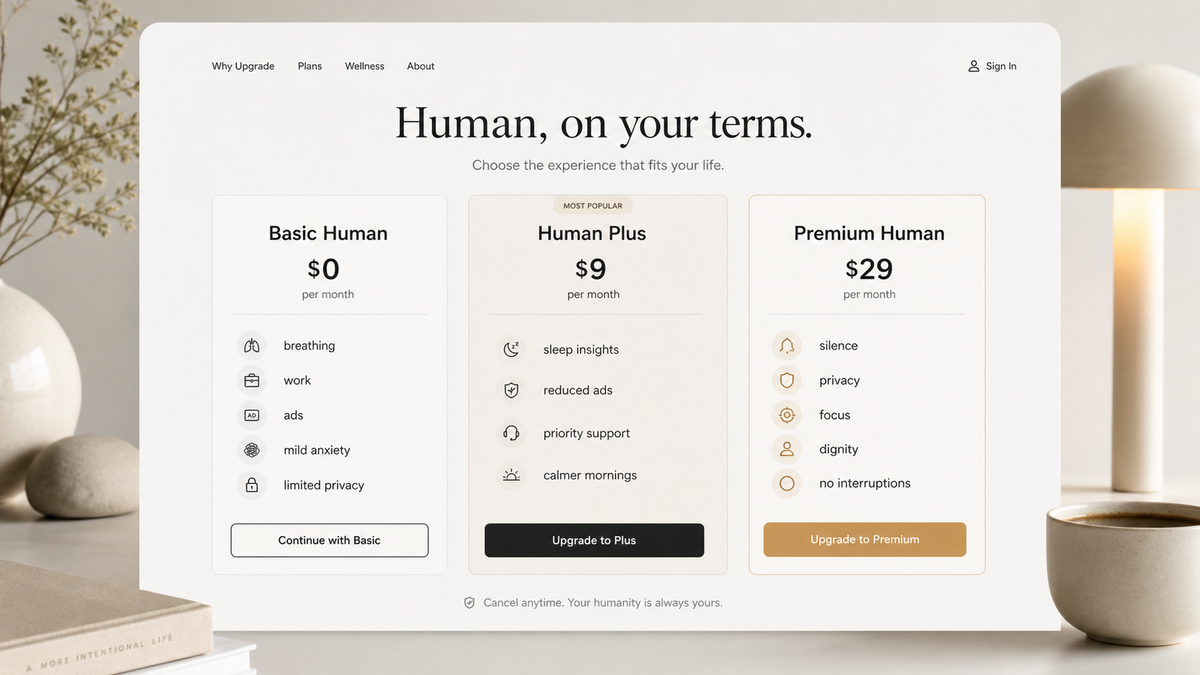
The free version of modern life is technically functional, but emotionally unusable.
The first time my lamp asks me to upgrade, I will probably laugh. Not because it is funny, but because laughter is what the body does when reality becomes satire without asking permission. Basic Light will still work, technically. It will illuminate the room with the emotional warmth of a hospital corridor. Soft Ambience will cost €4.99 a month. Human Glow will be bundled with Sleep Plus, Calm Mornings, and a seven-day trial of something called Domestic Wellness. Somewhere in the settings, under preferences, there will be a toggle for silence. It will be greyed out.
This is how the future arrives now. Not as a monster, not as a revolution, not as a dark prophecy wearing dramatic clothing. It arrives as a pricing page. It arrives with tasteful typography, a friendly notification, a button that says “Maybe later,” and the quiet implication that later will eventually disappear. The future does not need to kick down the door if the door already has an app.
At first, subscriptions felt harmless. Almost elegant. A small monthly fee in exchange for convenience. Music without shelves of CDs. Films without a trip to the rental store. Software without a box, a disc, and a manual thick enough to qualify as furniture. Fresh coffee beans arriving by mail. Cloud storage saving us from the small domestic tragedy of losing files named final_final_reallyfinal.docx. There was something civilized about it. Something clean. Why own every single thing when you could simply access what you needed, when you needed it?
Then the subscription stopped being a business model and became a worldview.
We did not only start paying monthly for services. We started accepting the idea that ownership was old-fashioned, access was modern, and dependence was fine as long as the interface was beautiful. The question changed quietly. It was no longer, Do I have this? It became, Can I still access this? That sounds like a small difference until one day your music, writing tools, storage, car features, home devices, reading archive, family photos, health data, sleep history, bank access, and ability to turn off the noise of modern life all depend on whether a company somewhere successfully charged your card at 03:17 in the morning.
The future will not ask, “Do you own this?” It will ask, “Is your access still active?”
That may be one of the most quietly humiliating sentences of the century. Not because monthly payments are new, and not because every subscription is evil. Many of them are useful. Some are genuinely good. The problem is larger than the individual service. The problem begins when access becomes the default relationship between human beings and the material conditions of their lives. A purchased object used to become quiet after the transaction. It entered your home and, with some luck, did its job. A subscription object never fully arrives. It remains in negotiation. It sits in your house like a thing, but behaves like a contract.
This is the permission economy. It does not sell products. It sells the temporary right to remain comfortable.
A chair used to be a chair. Soon it may become a seating experience with three tiers and limited lumbar support. Basic Chair lets you sit. Chair Plus remembers your posture. Chair Premium does not judge your lifestyle choices before breakfast. A fridge used to keep food cold. A future fridge may keep food cold only after you accept new terms, update the companion app, verify your household, and choose whether you want Recipe Suggestions with ads or Nutrition Intelligence Pro. A mirror may still reflect your face, but Confidence Mode will be available only in the paid version. A door may still open, of course, because nobody wants a lawsuit, but Advanced Security Insights will be available for only €7.99 a month.
The joke works because it is almost not a joke. We already live in a world where products can have features physically built into them but activated by payment. The capacity exists. The object can do the thing. But you, little monthly creature, must maintain your relationship with permission. This is not ownership in any meaningful emotional sense. It is cooperation with conditions.
When objects need accounts, ownership becomes cosplay.
The strange part is how politely all of this arrives. Subscription culture never walks into the room looking like a dystopia. It arrives with convenience. It says, “This will make your life easier,” and often it does. That is the trap. The best traps do not begin as traps. They begin as relief. Nobody wants to become the dramatic person giving a speech about autonomy because a toothbrush has Bluetooth. Nobody wants to sound like an ancient villager warning the children about the spiritual consequences of cloud storage. Nobody wants to be the woman at dinner saying, “Actually, I think my washing machine developing a payment relationship with a server farm is a sign of civilizational decline.” So we laugh, subscribe, accept the new normal, and forget that normal is something culture manufactures very slowly.
Convenience is the perfume of dependence. It makes the room smell harmless.
The real danger of subscription culture is not that it asks for money. Everything has always cost something. The deeper danger is that it changes the baseline. It trains us to accept worse defaults. More interruption. Less privacy. Slower access. Lower dignity. The basic tier still works, technically, which is what makes it defensible. But it works the way a hostile room works: you can stand inside it, but you are not meant to rest there.
That is why the free version of modern life is technically functional, but emotionally unusable. The unpaid version lets you participate while constantly reminding you of what has been withheld. You can listen, but with ads. You can read, but with interruptions. You can store your memories, but only until the warning appears. You can use the tool, but with a watermark. You can access the service, but more slowly. You can exist in the system, but with friction deliberately arranged around you like furniture in a room designed by someone who wants you to leave your wallet open.
The genius of the modern subscription model is that it often does not sell pleasure. It sells relief. Relief from ads, waiting, limits, pop-ups, degraded quality, dark patterns, and artificial inconvenience. First the world becomes irritating. Then the irritation becomes a product category.
First they sell us noise. Then they sell us the cancellation of noise.
This is where the future becomes less funny. Soon we will not subscribe only to entertainment, tools, and software. We will subscribe to silence. Not silence in the poetic sense, not a cabin in the mountains, not a romantic withdrawal from society with linen curtains and a ceramic mug. I mean ordinary silence. The right to use a thing without it speaking. The right to read without interruption. The right to walk through a city without every available surface becoming an interface. The right to open an inbox without being emotionally ambushed by companies pretending to miss you. The right to exist without your attention being treated like an unlocked bicycle.
Silence is already becoming a luxury. So is privacy. So is focus. So is slowness. So is human customer service. So is an internet experience that does not feel like being followed through a shopping mall by seventeen desperate ghosts. We are moving toward a world where the wealthy will not simply have more things. They will experience fewer interruptions. They will have cleaner defaults, quieter environments, better interfaces, less tracking, fewer ads, faster support, calmer tools, and more control over what reaches their nervous system.
Luxury used to mean having more. Soon it may mean being bothered less.
That is a much darker class divide than the old language of luxury can explain. The future rich may not be defined only by bigger houses or better cars, but by better atmospheres. They will live with less friction. Their children may learn from tools without ads. Their homes may contain devices that do not constantly upsell them. Their healthcare portals may be usable. Their cities may have quiet zones. Their inboxes may be filtered by assistants trained to protect their attention. Their privacy will feel normal because it will be bundled invisibly into the premium version of life.
Everyone else will pay in attention.
They will pay with time, irritation, confusion, exposure, tracking, waiting, and the constant small degradation of being pushed through the worse version of every system. This is the coming divide: people who experience life with ads and people who experience life without friction. A society reveals itself by what it makes conditional. When films become subscription-based, fine. When productivity tools become subscription-based, annoying but understandable. When privacy, repair, quiet, safety, mobility, warmth, and basic functionality become subscription-based, we are no longer talking about consumer preference. We are talking about the privatization of normal life.
The subscription age is not selling us luxury. It is slowly turning ordinary dignity into a paid upgrade.
This will not look cruel while it happens. It will look like choice. There will be plans, bundles, trials, annual discounts, family tiers, student offers, limited-time upgrades, loyalty rewards, and soft pastel landing pages showing diverse people smiling at devices that have never made anyone that happy. The word “control” will appear often, especially in places where you have the least of it. You will be told that you are empowered because you can customize your plan. You will be told that the system is flexible because you can cancel anytime. You will be told that everything is designed around you, which is true only in the sense that a maze is designed around a mouse.
Cancel anytime is the lullaby of a world where nothing is meant to stay.
Of course you can cancel one streaming service. You can cancel a productivity app. You can cancel a meditation subscription, which is a very modern sentence and should probably be studied by historians with a sense of humor. But you cannot easily cancel the world that made these systems necessary. You cannot cancel the expectation that every tool has an account, every device has an update, every document syncs somewhere, every interaction generates data, every convenience requires a login, and every login becomes another small administrative obligation attached to your life.
We outsourced ownership and somehow became unpaid administrators of our own lives.
That is one of the least discussed costs of modern convenience. It does not remove responsibility. It redistributes it into smaller, more annoying forms. Which card is attached to which service? Which email owns which account? Which app stores the archive? Which password manager holds the keys? Which storage plan contains the photos from years you barely remember but are not ready to lose? Which trial did you forget to cancel? Which software update changed the interface? Which company quietly became part of your daily nervous system without ever feeling important enough to question?
Modern convenience is mostly remembering which company currently controls which part of your day.
I do not say this as someone who hates technology. That would be too easy and too false. I like convenience. I like music appearing instantly. I like maps that know where I am. I like software that updates without requiring me to understand anything about drivers, patches, or the dark emotional life of printers. I like the small miracles of digital life. I like living in a century where a thought can travel faster than my mood. The critique matters precisely because the systems are useful. The dangerous things are not always the things we hate. Sometimes they are the things we love enough to forgive.
Access can be beautiful. Not everyone needs to own everything. Ownership can be heavy, wasteful, expensive, and absurd. The problem is not that access exists. The problem begins when access becomes the only realistic option, and ownership becomes impossible, impractical, or quietly punished. Then we enter the free trial of being alive.
The phrase sounds excessive until you look around. Basic life increasingly feels like a limited plan. You can function, technically. You can participate, technically. You can exist in the system, technically. But the better version of nearly everything sits behind a paywall: better attention, better sleep, better food, better healthcare, better education, better privacy, better safety, better mobility, better tools, better silence. Adulthood begins to feel like discovering which parts of being human were never included in the starter plan.
A free trial is intimacy with a countdown. It lets you feel what life could be like, then asks for payment at the exact moment your habits have adjusted. The product is not only the app, the tool, or the service. The product is the improved version of yourself that briefly appeared while using it. More organized. More rested. More focused. More musical. More intelligent. More in control. Cancellation feels emotional because you are not only ending a service. You are demoting a possible self.
That is why subscription culture reaches deeper than consumption. It does not only monetize things. It monetizes improved selves. Basic Human can still breathe, but with occasional interruptions. Basic Human can sleep, but without advanced insights. Basic Human can write, but with storage warnings. Basic Human can date, but the emotionally available people seem to be hidden behind a premium rose. Basic Human can be private, but not conveniently private. Basic Human can focus, but only after manually disabling fifteen systems designed to prevent focus.
There is something obscene about a society that creates overstimulation and then sells calm as a lifestyle product. First the world becomes difficult to endure. Then being able to endure it with good lighting becomes aspirational. We are sold nervous-system repair by the same culture that profits from nervous-system damage. We are sold minimalism through shopping, digital detox through apps, mindfulness through devices that interrupt us to remind us to be present. It would be funnier if it were less accurate.
The most unsettling part is that nobody has to be evil for the world to become exhausting. There does not need to be a villain in a glass office stroking a cat and plotting the downfall of lamp ownership. There only needs to be a spreadsheet proving that people will pay to remove a pain point, and a culture too tired to ask who created the pain. The airport sells speed because it created waiting. The app sells focus because it created interruption. The platform sells reach because it controls distribution. The device sells simplicity because it became complex. The service sells freedom because it first made you dependent.
This is not conspiracy. It is design meeting incentive meeting human fatigue.
So the question is not whether every subscription should disappear. That would be childish. The question is what should never become a subscription. Repair should not be a subscription. Privacy should not be a subscription. Silence should not be a subscription. The ability to use a thing after buying it should not be a premium feature. The default state of a human life should not be Basic with optional dignity upgrades.
A sane society draws lines around certain things and says: no, this is not a tier. This is not a plan. This is not a growth opportunity. This is not a monetization layer. This belongs to the human baseline. But we are not very good at baselines anymore. We understand premium, pro, plus, elite, platinum, exclusive, enhanced, optimized, personalized, and limited access. We understand the little glow around the paid tier. What we have forgotten is the moral importance of enough.
Enough is dangerous because enough does not beg to be upgraded. Enough does not keep the user engaged. Enough does not send a retention email. Enough does not produce a quarterly growth story. Almost is where the money lives. Almost comfortable, almost private, almost quiet, almost functional, almost rested, almost free. The modern market does not always deny you things. It often gives you a degraded version and waits for your irritation to mature into revenue.
This is why the subscription of everything should bother us. Not because monthly payments are uniquely evil. Not because technology is ruining the purity of objects. Not because ownership is always noble. It should bother us because it trains us to accept conditionality as normal. It teaches us to experience life as a stack of access privileges. It makes the basic world worse so the paid world can feel humane.
There is a dignity in objects that do not know your email address. There is a dignity in tools that do not ask for engagement. There is a dignity in silence that is not branded. There is a dignity in a lamp that turns on without wondering whether you are still a viable customer. Perhaps that will become the real luxury: not gold, not automation, not status, but objects that shut up. A home without subscriptions. A tool without a login. A morning without prompts. A room where the baseline is not designed to disappoint you into upgrading.
The future does not have to become the subscription of everything. But avoiding that future requires noticing how seductive the present version feels. It requires saying no before the absurd thing becomes normal. It requires defending boring ownership, boring privacy, boring repair, boring silence, boring functionality. It requires protecting the unglamorous right to buy a thing and have it remain a thing.
The lamp should not have a business model. The chair should not have a roadmap. The fridge should not need to scale. The door should not be exploring new engagement opportunities. The mirror should not suggest a confidence upgrade. The bed should not put rest behind analytics. The shower should not have a dashboard unless something has gone terribly wrong.
There is a beautiful simplicity in things that simply do what they are.
And somewhere in that possible future, a tired woman will stand in her apartment while her lamp offers three options: Basic Light, Soft Ambience, and Human Glow. She will stare at the screen for a second too long, not because she cannot afford it, and not because she does not understand the menu, but because some small ancient part of her remembers that light was not always a relationship.
Once, it was just light.